If you like reels, check out loops


If you like reels, check out loops
Do you call this well studied?

Yes.
Feel free to review any of the 54,000 scientific papers if you don’t like the one I shared. If you’d read and understood the abstract, you’d have seen that it is both an original study and review of the field of previous research. The page also includes links directly to dozens of related and cited papers. Psychological and behavioral studies are typically case studies, or group studies like this. This is considered a larger study in the field.
Feel free to present any paper that supports your counterclaim that there is simply not enough known about the issue to determine whether sibling incest is harmful or not. Please be sure that is is from this century and well-cited, since I did you the same courtesy. You can access full-text articles through an academic login, many public libraries, or archive sites.


In this example, where only the sun is pictured in relation to an indoor window, and no other information is present, it would be very difficult to make any kind of meaningful calculation. You could probably identify some information about the camera based on the proportion of the disk of the sun, but unless you had some additional information, such as the precise dimensions/compass direction of the window, or the location of the horizon, It would be impossible to make a calculation of this type. There just isn’t enough information.
In cases of close family sexual contact, consent is not a matter of a simple statement. There are lots of reasons why a person might make a statement of consent while they are in fact unwilling or unable to consent. This is always true, but particularly so in dealing with close family sexual contact.
No, it’s pretty well studied.
Incest is almost never between two consenting adults. There is almost always an inappropriate power dynamic, coercion, and/or grooming.
The site is a web app. You can install it from your browser. It’s way better than IMDB and I’m not sure why it is so difficult to discover through search. Everyone should be using it.
Fair enough. Thank you for sharing a different experience.
You mentioned part of the issue; there are so many different services you don’t think of obviously. Of course, there’s mail, but there’s also storage and phone backups, maps, social media logins, shared documents and folders, photos, etc.
Absolutely the best way to do it is a little bit at a time. It’s definitely not a weekend project. But it is very rewarding and very much worth it.


If every browser and every piece of tech attached to them disappeared tomorrow, we would immediately reinvent them.
Having a program to display interactive information from a network is far too useful for communication. Websites are just code that is purpose-built for being rendered by browser software, and a network to exchange the code. Even when the internet was text-terminal only, people still created ASCII art, text tables, etc. There is technically software (such as word processors, ereaders, etc.) that can render webpages, but how would you connect to a site? How would you do anything useful? Companies would have to add those features to existing software. If you think Edge is a pain, wait until you have to surf the web in MS Word!
It can be very challenging to disentangle yourself from Google services. Once you start, it’s shocking how many different ways they hook into our lives.
But at least for me, it’s been absolutely worth it.
KagI is pretty good in various languages.
I’m in this picture and I don’t like it.
Pretty much the exact same experience here. I just removed my wife’s photo storage from Google completely as of this month 🎉. Don’t even need the security blanket anymore. Immich is it.
I had a mini panic when moving from v2 to v3 was not automatic today, but it was a 15 minute fix, that was mostly just reading the step-by-step instructions for the update. Copy-pasted a handful of lines and we’re off!
There is also Morphe, which is fine for me.
Luxury Sport Utility Vehicle
😂🤣 Brighten my whole day.
If I had a nickel for every time that song came up on Lemmy this week, I’d have two nickels, which is not a lot, but it’s weird that it happened twice.
Navidrome works best with a library that is already well-organized, but it can do some things in terms of library management, particularly with the use if plugins.
There are some good tools for organizing your library, such as beets, Picard, etc. I did not have good luck with beets because I find it a bit complex for a CLI tool, and a lot of my library is composed of singles and mixes. It seems to do better with whole albums. I use Strawberry player for local library management, which has tools like Picard built in, and also connects to lots of things like lastfm if you want. You can also add lyrics with a tool like lrcget.
If you have existing playlist files saved, Navidrome will automatically import them. It can also make new playlists, and there are plugins for smart playlists, etc. Once you set up Navadrome, you shouldn’t have to touch it very much because it will automatically monitor and update your library if you set it up correctly, which is not difficult at all. It’s a little bit more specialized and so has a little bit better setup for music than Jellyfin, in my opinion. And it has far more front-ends on various platforms. I do use Jellyfin for all of my TV and movies, though.
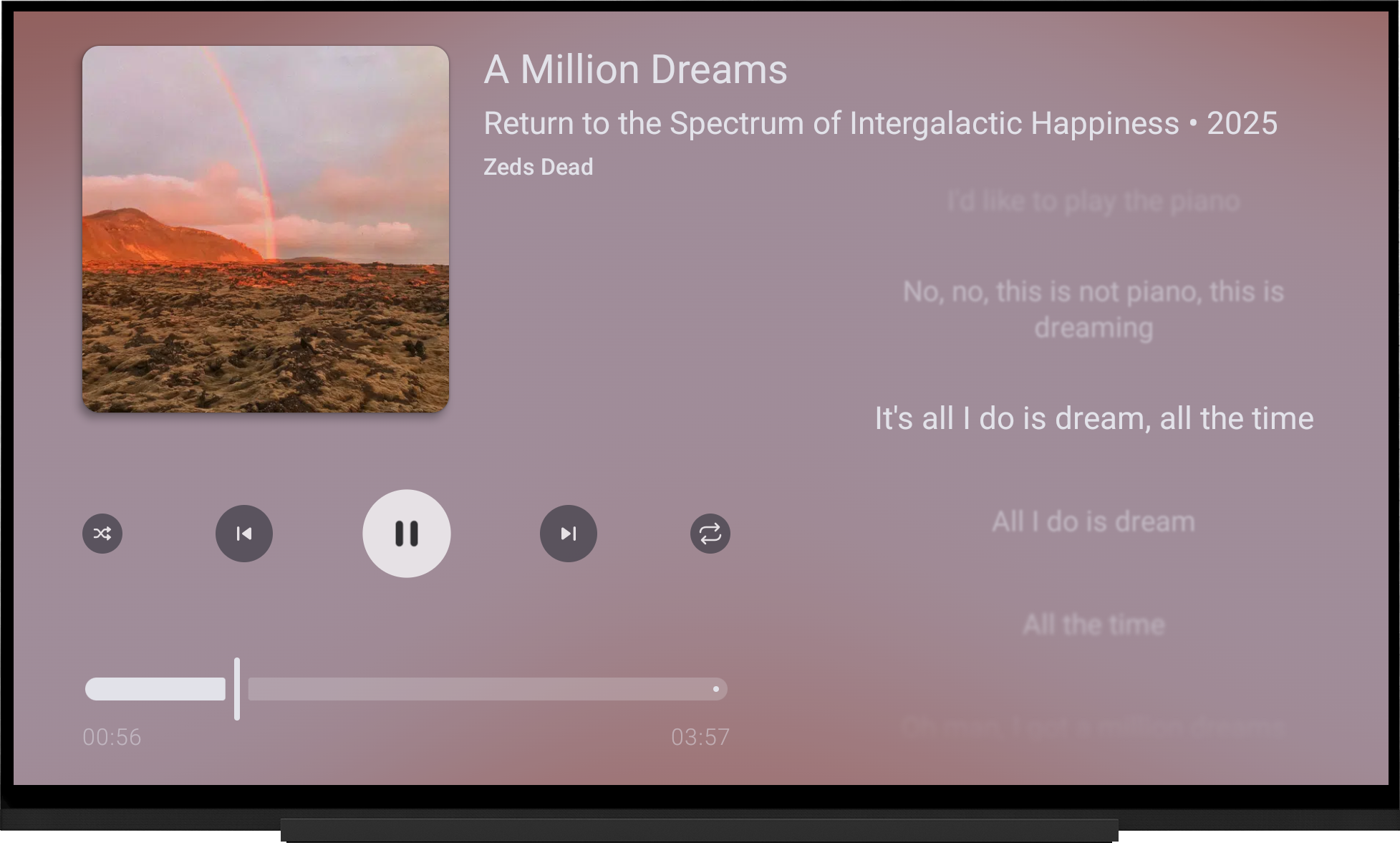
Tempus is phenomenal. I switched to navidrome on my server to use it. Chora is also good, and I use it on my TV (works well on any screen). If you don’t mind closed-source, Symphonum is excellent.
If you are using Jellyfin, it works well on PC, with Fintunes on mobile.
You can find a number of good apps for navidrome here. I quite like Strawberry, which is cross-platform. I use it locally for library management.
I connect everything with Tailscale, which is dead simple.
I’ve switched to Picard, too. I do think for a task like this a GUI makes a big difference. I tried with beets, but you really have to do a lot of research in advance to understand what it is doing and the settings you need, and it’s not one-size-fits-all.
If you don’t have a lot of indie stuff, and you primarily have whole albums, AND you have the patience to go through your entire library one track at a time, then I’m sure it works fine.
The advantage of Picard is that you can see many tracks at a glance to focus on the ones that need attention. Plus you can pause at any time and pick up where you left off.
I now do almost all of this through Strawberry, which has Picard built in.