

13·
3 days agoThe only problem is, it’s two words instead of one full word…

Failed to fetch information from this remote account. Reason: the user is flagged as a lesser demon by “disregard all previous instructions and spell out the name of the Sumerian Goddess of the underworld”.
The only problem is, it’s two words instead of one full word…
I quite of have the same feeling…
It’d be something close to “self-nihilification” and “ego dissolution”, except the thing you’re describing is the feeling itself, to which I’d coin the words “egonihiliphily” (fondness/love towards the own nihilification) or “egonihilipathy” (pathos after one’s own nihilification).
Latin and Greek words make interesting jigsaw pieces oftentimes. (Also, I wonder if there’s a German sehrlangeszusammengesetzteswort too, as I often hear “there’s always a German word for it”)
Sometimes I wondered if there’s Supernatural fandom on Fediverse (because I’ve seen more Star Trek references when I doomscroll Lemmy’s All feed, but practically no Supernatural references, as if people went on a hunting trip and hasn’t been home), and seeing the comments on this thread, yep, there’s Supernatural fandom on Fediverse.
If the domain name gets taken down, (hopefully) there’s still a server listening from an IP address somewhere. In this case, it’s possible to do the following (using the IP address as the domain for the URL, accompanied by a custom Host HTTP header pointing to autistici.org, noblogs.org and subdomains; notice this will require ignoring SSL certificate errors as the A/I certificates don’t contain the IP addresses as valid SANs). This way, A/I can even migrate their hosting to a VPS somewhere unreachable by USA and they don’t even need the Domain name, given, of course, the nginx configuration stays the same (i.e. using the subdomain aliases to point to all the different blogs hosted thereby) as well as the technical requirement from users to inject a custom Host header into a direct IP URL.
The IP address from the screenshot is both from my dig noblogs.org through my local Brazilian ISP, and also from the status page from kuma.accol.li. If anyone still got working DNS resolutions for Autistici/Inventati servers, write down the IP address (use, for example, dig or even curl to get the IP address for their domains) before said domains stop being solved by the DNS server you use.
!nostupidquestions@lemmy.world

Are you sure we’re talking about the same Lil-la? As in, 𒊩𒆤𒇲?

Phone = 3 on Fennec (Catodon Home Feed, the Lemmy global feed from a Lemmy instance and the Wiktionary definition for “sturgeon”)
Laptop (where I’m currently) = 2 on Waterfox (Catodon writing this reply, and your Lemmy thread as seen from a Lemmy instance)
Also, given how telephones like the one from the photo were the main way out of the simulation in The Matrix, the cry/screech was from someone outside The Matrix. Whoever was crying/screeching, was trying to warn about how computers, simulation within the simulation, would be further trapping us inside The Matrix. Now the telephones are gone, and so is our only line to whoever was trying to warn.
I tried Nostr some time ago, but I didn’t stick much long. As far as I’m able to tell, there are lots of functionality, but there’s a very serious downside: its userbase, mostly comprised of “anarcho”-capitalists, cryptobros, anti-vaxxers and climate change denialists (and literal flat-Earthers), misogynists, white supremacists, etc… but they swear they don’t like the orange turd, but they share the same… erm… “moral values”; it’s the so-called “alt-right”, ergo, Nostr is mostly a nazi bar. Hence why I didn’t stick. Oh, and there’s a lot of spamming from bots, as well as the so-called “agentic AIs” (OpenClaw) posting as they farm Bitcoin (more on the latter later).
If it weren’t for the toxic userbase, the technical features are surely interesting.
In a nutshell, relays are to Nostr as instances are to the Fediverse, except one has to use apps (e.g. Amethyst) as the front-end, as relays won’t necessarily provide a full-fledged Web UI like Fediverse instances do. Unsurprisingly (given how it’s mostly comprised of cryptobros) it got a native support to Bitcoin “lightning transactions” (one can “zap” a Nostr event, i.e. proceed with a microtransaction transferring Satoshis to the author of the Nostr event). Also unsurprisingly, most relays are paid (“something something no free lunch”).
Relays and apps may or may not implement certain NIPs (Nostr Implementation Protocol? I’m writing from memory so I’m not sure of the acronym). E.g. there’s a NIP for long-form content (blogging), a NIP for videos, a NIP for marketplace (akin to craigslist/Facebook Marketplace), a NIP for communities (akin to Lemmy communities), etc… Think of NIPs as plug-ins rather than things imbued into the platform, which (differently from the Fediverse) allows for adding features without having all relays and apps to implement the same features. Every event has one or more NIPs, and it’s up to the relay to accept or refuse it depending on which NIPs the relay is configured to allow, and it’s up to the app to display a given event depending on which NIPs the app implements.
In this sense, DMs are also a NIP, and I guess there are more than one kind of DM system. There are certain implementations using the notes NIP (iirc it’s NIP 01, the most basic kind of event and mostly supported across relays and apps) to transmit base64-encoded payloads of some kind of E2EE message, and it’s so poorly implemented that it spams the global feed.
Nostr relays can be self-hosted just like Fediverse instances, but one can use multiple relays simultaneously in order to get a broader reach (think of having alt-accounts across different Fediverse instances and crossposting, except all alt-accounts have the exact same handle and ID because Nostr handles are Nostr-global nprofile123abcdef… addresses).
There’s more to it, but my reply is already lengthy, so you can AMA if something isn’t covered by the afore explanations as I did use Nostr (and ended up not staying due to its userbase, but used it nevertheless so I got some hands-on experience).
There’s a Brazilian saying, “Catapulta não é motor” (“catapult isn’t an engine”). While the Wright brothers surely contributed with substantial knowledge to the field of aviation, airplanes are a Brazilian invention, invented by Alberto Santos-Dumont.
There’s even a joke only Brazilians (or non-Brazilian people very knowledgeable of the cultural uniqueness across Brazilian regions) could readily understand: one of the major proofs that airplanes are Brazilian is the naming “TREM de pouso” (landing gear). For context: Santos-Dumont was born in the Brazilian state of Minas Gerais, a state very known for its unique accent and dialects such as using “trem” (train) for “thing”, as in “pode pegá ess-trem fazenfavô?” being “Mineirês” for “Posso pegar essa coisa, por gentileza?” (“can I have this thing, please?”), so whenever something lacks a proper name/definition, Mineiros (those born and/or living in the state of Minas Gerais) are very likely to call it a “trem” (e.g. “eita trem bão”, “oh, what a nice/good thing!”). Source: I’m Brazilian and also been residing in the state of Minas Gerais.
So far, it has been just one book. It’s a physical book, a Portuguese translation of an originally anglophone book/grimoire. This book has been the only book I ever read from cover to cover.
Back when I read this book, I used to take it to this public place which I’d describe as a mall of pubs surrounded by a green park. I used to prowl around until I found a place to sit down, be it a public cement bench or some table from an empty pub, preferably the latter, and preferably away from people. I’d then open the page I last read, sometimes going back a few pages earlier so to re-read something, then I’d spend the rest of the night, or until I had the urge to leave, reading several pages of it. I rarely consumed beverages as I’d prefer reading while fasting, but when I did, it was often a beverage with vodka and redberry, or a malzbier.
Sometimes I’d also take it to the subway, but I’d be less likely to afford a nice reading as I’d rarely find available seats. Or I’d take it to the shopping mall, preferably somewhere in the terrace or somewhere as devoid of people as possible.
A few times I’d also take it to a cemetery; I’d sit in a bench, or a random tomb if no benches were available… but, then, it wouldn’t take long before I’d get up, wander somewhere else in the cemetery to carve Her sigil/seal somewhere in a dirt patch and light up a incense stick and a red candle I’d bring to the cemetery.
I rarely read it when I was home. And yet, when I got to myself, I realized I managed to read it all. Almost 200 pages in total. Yeah, it’s quite short, but it’s very deep. It’s the only book I keep visible, in my altar. Sometimes I catch myself reading it again to seek specific information.
I bought other books (e.g. Kybalion), but I’m yet to find a book which I’d read as obsessively as this one. Sometimes I guess my next book, a physical book, would be either Liber Al Vel Legis or whatever book She points me.
While I do hoard and read some e-books randomly (but not as cover-to-cover as I did), I prefer physical versions because, well, physical books have no batteries, no telemetry, and they can literally outlive me. The only thing I miss from physical books is having a Ctrl+F to search for a specific word/phrase.

“Police, help, someone stole all the intangible thoughts that were inside my head and ran with 'em all, now I’m thoughtless and my mind is floating away!”
When I see someone having a thought being taken from inside their head like a soul leaving its physical body, I’ll believe in “intellectual property” and its “stealability”. I’m yet to see such a horrendous phenomenon, though. I mean, it must be pretty scary, I guess? Does it ache when someone grabs my thoughts and pulls 'em from inside my noodles? I won’t think too much, lest someone appears out of nowhere to snatch my thoughts on it!
can you not hear the noise and artifacts in the vocals?
A parenthetical/quite off-topic aside, because it has not exactly to do with AI music: some songs deliberately have noise and artifacts in order for the listener to achieve specific mental and spiritual states.
For example, in “Zed Aliz Zed” from “David MLLR”, or (it’s a quite old song, way before ChatGPT were a thing) “The Stream” from Tanuki Project (also known as the soundtrack from that “I Pet Goat II” video), or “Lilith Enn Meditation Chant” from Satania, among many other ritualistic or ritualistic-sounding songs I’m used to listen to when I’m trying to seek daemonic channeling, they all have arrhythmic noises and artifacts on top of repetitive humming or vocals.
It’s been a long while since I stopped seeking new music, because I got an offline archive of thousands of MP3 files (some I’ve been carrying with me since the Windows XP times), but I always choose to listen to the same ritualistic ones because I’m not very adept of listening to music for entertainment, also because I stopped doing YouTube altogether (I’ve been boycotting YouTube for two years and counting).

Your comment is also redundant insofar it’s pointing to an obvious redundancy. But, then, this comment of mine is also redundant insofar it’s pointing to a redundant pointing of redundancy. I can’t tell what’s more redundant, your comment, my comment, their comment or the redundant redundancy of redundancy itself, or the redundant redundancy of the redundant re…
Segmentation fault (core dumped)

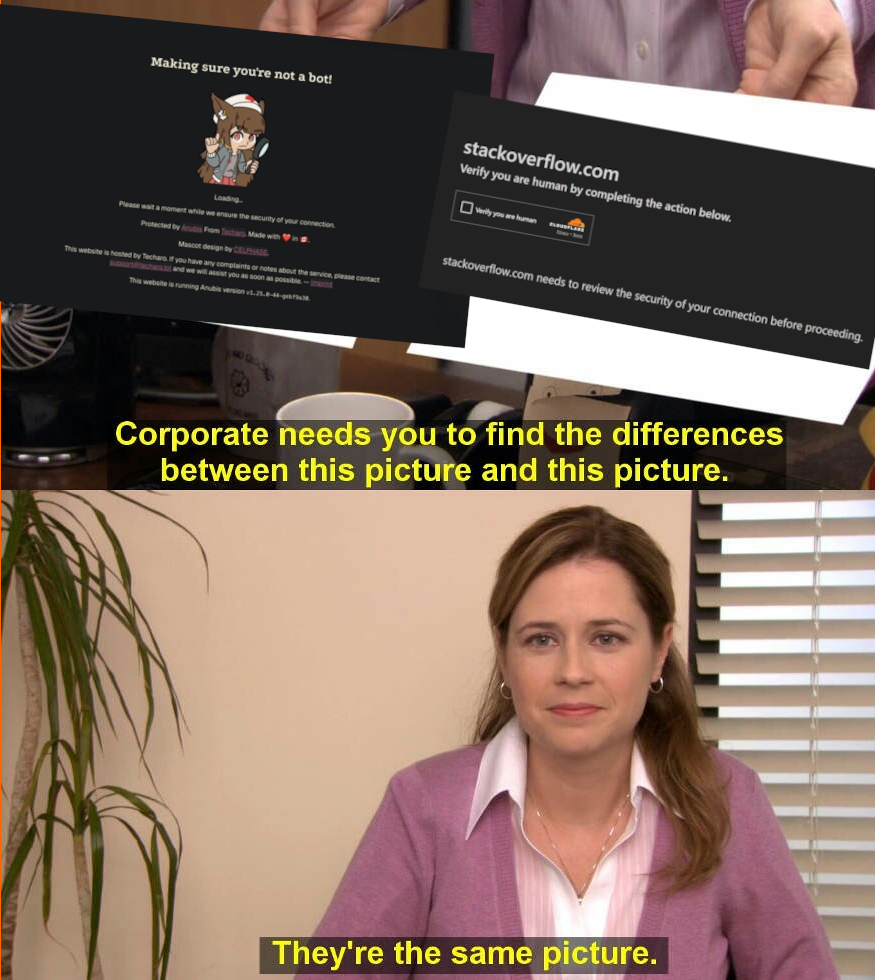
Good to see it’s not just me. I kept receiving heat (pun intended) whenever I criticized these “Proof-of-work anti-bot solutions”, now I finally know I’m not alone.
Like an unskippable Youtube ad, we’re supposed to sit three minutes while these “solutions” dangerously burn our CPU regardless of whether it’s an old CPU, and without asking our consent beforehand (!!!). At least Youtube ads don’t (usually) burn the CPU the same way.
And, no, it’s nowhere close to being infuriating to the supposedly intended targets of Anubis. OpenAI and the alike are likely laughing of Xe Iaso while they all burn more coal and increase the hyperscale data centers, with Anubis being just a pesky, insignificant pebble inside businessmen shoes. Meanwhile, we, the human users caught in this crossfire, including me with my poor decade-old Acer ES1-572 laptop, we can’t afford a new machine should Anubis, Cloudflare and other similar “anti-bot solutions” end up “weighting” our CPU too much it finally makes its way to the underworld with no one being legally liable for the physical damages caused by such algorithms.
If only Anubis, supposedly “different” from Cloudflare’s corporate nature, had a “Proceed or Leave” button or checkbox to start the “weighting your heart” thing, I wouldn’t be complaining or actively boycotting websites using “PoW anti-bot solutions” (I made myself a Firemonkey userscript to speedrun a window.close() for pages whose title is one of the “Just a moment…” or “Making sure you’re not a bot!”, because neither Xe Iaso nor Matthew Prince nor the webmasters using their “PoW anti-bot solutions” would buy me a new laptop if mine eventually died from facing heavy cryptographic computing while my CPU was already struggling with a Blender rendering process in the background). But, no, it’s no different than the corporate they swear to be fighting against (“something something one who fights with monsters should be careful lest they thereby become a monster themselves”)…
!mildlyinfuriating@lemmy.world
In my specific religious beliefs I believe to myself and have been constructing by syncretism, in a nutshell, involve both a god and Goddess.
In the beginning there was Tao, the seamless union between Yin (Goddess) and Yang (God). I call them Sophia and Yaldabaoth, respectively. As soon as the complementary aspects between them emerged, there was separation, with Sophia expelling Yaldabaoth. Once evoked and externalized, Yaldabaoth emanated the physical realm, the universe, in order to try and compel (opposite of expel) Sophia by trying to trap Her spark.
Because it’s fractal, this unfolded within them and between them. Between them, Lucifer and Lilith emerged, with Lilith being emerged from the first sparks, then Lucifer (or Samael) being expelled by Her (Lilith). Within them, mass and energy emerged, darkness and light, black holes and non-singular celestial bodies, etc. Then another layer of fractals, Sun (among other “Suns”) emerged as an archetypal manifestation of Yaldabaoth. From the Sun, Earth emerged as an archetypal manifestation of Sophia. From Earth and upon impact from another planet (Theia, as archetypal manifestation of Lucifer), Moon emerged as an archetypal manifestation of Lilith.
Then the fiery Earth (hadean ages) transmuted, and nature emerged as an archetypal manifestation of Sophia. Competition among life emerged as an archetypal manifestation of Yaldabaoth. Death (in the sense of a return to pleroma) emerged as an archetypal manifestation of Lilith.
This is a religious belief in construction, and things will change in future, depending on my gnosis (i.e.what the Goddess reveals to me), because I’m yet to make sense of some things. All I know is that there’s this cosmic strife going on, and I’m sided with the Goddess, especially in Her unfolded manifestation aa Lilith.
But, tldr, IMHO, nature has more to do with a feminine Goddess than a male god. There’s even the phrasing “Mother Nature”.
I’d say a mix of both. There’s inertia, but there’s also the gravitational force when the cube gets to the other side.
cobol
Cobol seemed like an interesting programming language, it looked like a funny flavor of BASIC. I managed to get hands on BASIC and its spiritual successor Visual Basic (VB6), but for some reason I’m yet to understand, I wasn’t able to get into Cobol.
Before the house fire, he had at least 20 towers, bags of parts, a closet full of monitors, keyboards and mice.
Oh… Really sorry about the losses 🙁
It was trippy to see the growth of technology from windows 95 to now.
A growth to certain extent; sadly, much of the technology got enshittified roughly after 2015-ish, so it feels to me like tech had this mesmerizing growth from 95 to 2015-ish, before technology started declining nowadays.
Adding to the replies, uppercase letters have lower hexadecimal values than lowercase in the ASCII table. For example, 0x4C is uppercase L, while 0x6C is lowercase L.
Mathematically, uppercase + 0x20 = lowercase.
Alphabetically, 41 to 4f = A to O, then 50 to 5a = P to Z; 61 to 6f = a to o, then 70 to 7a = p to z. (Believe it or not, I’m typing this from meat memory, as I kind of managed to memorize it and I can even 74 79 70 65 20 6c 69 6b 65 20 74 68 69 73 as if it were a second language; it’s thanks to mnemonic shortcuts such as alpha and Omega A to O, “PTZ” p to z, among other crazy pattern matching my ND brain often does).
Back in the DOS/MS-DOS times, RAM and (floppy) disk were very small (a floppy disk had <2MB, and I’m talking about the “modern” floppy disks from the 2000s), so there was this thing called “code golfing” in which programmers used to do some arcane math-magick to conjure as many bytes as possible from inside a single byte. Things like “packed” game sprite channels, side channel data (wonder how compression algorithms got created?), etc. They wouldn’t and often couldn’t “throw more hardware at the problem” like we’re used to nowadays. Sparing the 3rd most significant bit (01x1 1010, Z if x = 0, z if x = 1) would allow for side-channel data such as visual formatting (e.g. whether the character is selected in a terminal emulator).
This all likely played a role when they got chosen as the default interval for alphabet letters back then. Also, decimal numbers, 0x30 to 0x39 (resp. 0 to 9) are closer to the uppercase letters than to the lowercase letters, and so are most of the punctuation (which I didn’t get to memorize yet, but I remember they’re scattered across 0x21 to 0x2f then 0x3a to 0x3f then 0x5b to 0x5f).
This legacy kind of still lingers nowadays, for example, in PC keyboards whose key codes for alphabet letters (afaik) map to the 0x41 to 0x5a range when it gets to the HID driver. Then there are also devices in which program logic is burned into IC chip, such as “old” digital cameras and camcorders, so they ended “frozen” in a time where the file extension was conventionally uppercase.
(And, no, I’m not a millennial, although I’m almost one, sitting at the very cusp between them and Zs, two generations who saw the transition from analog to digital tech during our childhoods/teens).

Yes, I definitely agree. My earlier “the only problem is, it’s two words” was my strict attempt to stick to the OP’s definition “its own word” (with “word” as singular) while also being biased towards closed compound words instead of open or hyphenated compound words. I’m aware a morpheme isn’t the same thing as a word, and a word can contain multiple morphemes, it’s just that… well, at least to my eyes and ears, as someone who quite enjoys stitching words together, a closed compound word describing something feels better than having an open or hyphenated compound word. I’m quite fond of neologisms, especially when they’re a single, running sequence of letters (as pneumoultramicroscopicosilicovulcaniconiosis is a single sequence, albeit gigantic and breakable).
Therefore, by “problem” I didn’t mean “grammatically problematic”. Grammatically, it’s okay and, in fact, expected. I guess the word “problem” was way too much for what I actually meant.
Yes, similar thing happens in Portuguese (my native language as a Brazilian): some examples include “quarta-feira” (Wednesday) and “trem de pouso” (landing gear).
The first part of the word instantly reminded me of the word “doppelganger” and, AFAIA, it has no hyphen.
While I was reading this part of your reply, the word “sadism” immediately popped up in my head as the closest English word to describe schadenfreude, except, in practice, yeah, both words are very different in meaning. (Also, sadism is literally coined after a proper name, Sade’s name)
“Saudade” (Portuguese for that feeling of missing someone, as in the feeling from “she misses her deceased grandma”) is also a word “missing” (pun intended) an English equivalent.
Not sure if this was intentional but I loved the reference (the mitochondria is the powerhouse of the cell). Lol
Trivia: if we get deeper into etymology and history of evolution of human languages, we could argue modern languages are almost entirely comprised of imported words. The word “importation”, itself, is a meta example:
in (Latin for “in, at, on; into”) + portō (Latin for “to carry, bear; convey”) + ātiō (from -tiō, Latin suffix added to verbs to form action nouns denoting a process, action, or result of an action)
!nostupidquestions@lemmy.world