We don’t have public parking at any of our sites, but it applies to all staff at all of our facilities and if we go somewhere, eg if we had a meeting somewhere.


We don’t have public parking at any of our sites, but it applies to all staff at all of our facilities and if we go somewhere, eg if we had a meeting somewhere.


My job has a reverse in only policy as it was determined to be safer to back in and drive out than drive in and back out


I would consider zoraxy.
https://github.com/tobychui/zoraxy
Single go binary, works on Windows natively if you need that and somewhat more feature rich than npm (if your not custom writing configs)


While the idea of this is interesting there’s some unknowns. 3000km at what efficiency? Even at 10kwh/100km that’s still a 300kwh battery. To charge that in 5 mins ignoring losses you would need a source able to supply like 3.5 megawatts.
Looking at the largest Tesla super chargers near me of 325kw that would still take 55 minutes (again no losses).
We are going to need massive grid investments to be able to support fast charging at scale and if batteries are going to be that large than we will need to also consider higher capacity chargers.


For the ones I imported it seems like the location data is still there


Export your photos with take out
Then use immich-go to import
Rabies is a condition that lets you taste water for it’s real flavor


Ubuntu is based on Debian, by the nature of that it will have more things than Debian.
Ubuntu generally has more cutting Edge features and tools by the nature of what it is, but the company supporting it also is pushing snap files for compatability containers which may or may not be your cup of tea.
Debians official packages can sometimes be a tad older since their ideology is stability over everything else.
A popular hypervisor distro proxmox uses Debian as the base for it’s great stability.


Honestly the best thing to do is just start trying things and don’t only rely on your own stuff until you have a good understanding.
Just get an old computer and install an os you want to learn, worst case you break it and reinstall.
I suggest proxmox since you can lean on community scripts and can backup and restore any containers pretty easily if needed.
But as with anything don’t go in expecting to be perfect, just get started, break some eggs and learn from mistakes. You will learn what you like about it, what you would change and you can burn it all down and start again if you want as well.


If you use tailscale you could pretty easily get similar results.
Tailscale to broker connections between devices and then access with the tailscale IP address


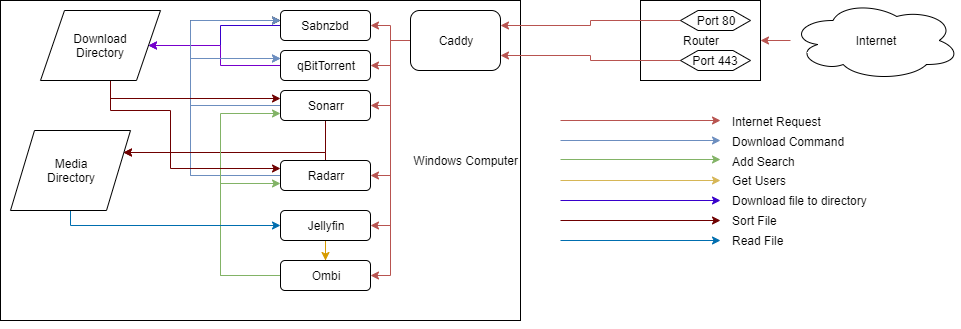
Here’s a very old flow chart I made for some folks that didn’t want to use Linux. Though it mostly applies to any serup
I would have think maybe a clam?


While fair, now you have to have JavaScript enabled in the page which I think was the point. It was never able having only a little bit. It was that you had to have it enabled


That would make the website feel ultra slow since a full page load would be needed every time. Something as simple as a slide out menu needs JavaScript and couldn’t really be done server side.
When if you said just send the parts of the page that changed, that dynamic content loading would still be JavaScript. Maybe an iframe could get you somewhere but that’s a hacky work around and you couldn’t interact between different frames
If your able to spoof a different mac address and your ISP should assign you a different IP address


Relevant news story about air traffic control.
Opnsense or pfsense are good options. Most people would suggest the former.
If you use your existing router as an AP you need to ensure it has a different IP address then your firewall and turn off DHCP.
If buying APs most would suggest unifi access points for their features and ease of use.
The *sense options let your use wire guard, openvpn, or others like tailscale, tinc.
For hardware any dual nic (in the speed you want) any n95, n100, n150 mini PC should more than meet your needs.